
The Enigma of the Zatrikion
What is it?
The Ancient Game Board Found in the Palace of Knossos That No One Knows How Was Played

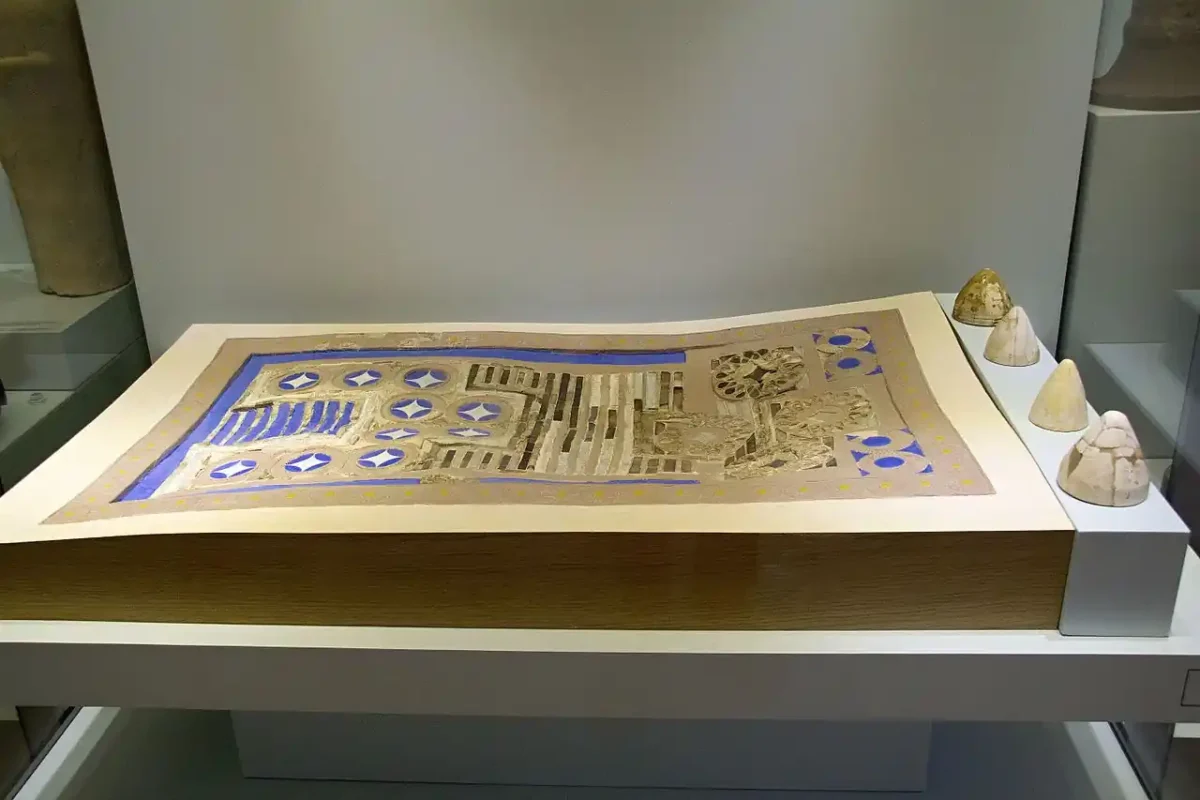
Arthur Evans found in Knossos a unique piece of ivory, gold, and crystal. Some believe it was a royal pastime; others doubt it was ever used for playing. Archaeology has yet to solve the mystery.
In the spring of 1900, the British archaeologist Arthur Evans began the first systematic excavations in the palace of Knossos, the mythical labyrinth of King Minos on the island of Crete. Just a few days after breaking ground, his workers uncovered an object unlike any other. It was broken, buried about 70 centimeters deep, in a corridor of the palace’s northeastern wing. Its fragments of ivory, rock crystal, lapis lazuli, gold, and silver still shone beneath the millennia-old dust.
Evans called it Royal Gaming Board. Over time, the discovery would receive other names: Knossos chessboard, royal chess-like game, and, above all, Zatrikion, a Greek word that simply means “game board.” Today it is on display at the Heraklion Archaeological Museum, where the label identifies it as Ζατρίκιο (Zatrikio) and, in English, as Draughtboard. An exact copy is also held at the Metropolitan Museum of Art in New York.
But the most surprising thing about the Zatrikion is not its beauty, but what we still don’t know about it. For over a century, specialists have debated whether it was truly a game board or simply the decorated lid of a wooden box. And, if it was a game, no one has been able to explain with certainty how it was played.

A Luxury Object in the Heart of Minoan Power
The Zatrikion belongs to the height of Minoan civilization, between 1700 and 1450 BC, what archaeologists call the new palaces period. Other sources date it slightly later, around 1600–1500 BC. In any case, it is over 3,500 years old. It is contemporary with the great Egyptian temples and the first writing tablets in Greece.
The object measures 96.5 centimeters long by 55.3 wide, although some descriptions put its size at 120 by 60 centimeters. It was made of a thin layer of ivory that probably covered the lid of a wooden chest. On that surface, Minoan craftsmen inlaid rock crystal and a blue-colored glass imitating lapis lazuli, a semiprecious stone brought to Crete from the mountains of Afghanistan. All of it was partially covered with sheets of gold and silver.
The frame of the board is decorated with 72 carved ivory daisy flowers. At one end appear four large circular medallions arranged in the shape of a cross. Around them, pairs of spirals in opposite directions fill the empty spaces. Each medallion has an outer ring of ivory, with inlays of silvered glass and rock crystal. In the center of each circle shines a curved-sided diamond. The Greek texts describing the piece also mention two large nautiluses (marine mollusks) in symmetry and a central rodaca, a type of flower or rosette with a white diamond inscribed.
Between the four medallions and the other end of the board stretches an H-shaped area, formed by alternating bands of flat rock crystal and rounded ivory strips. Beyond that, the piece is completed with ten small white diamonds, each inscribed within a blue circle. These ten elements are arranged in a central group of four and two lateral rows of three. The space between them is filled with more strips of ivory and crystal.

The “Draught Board Corridor”
The place where the Zatrikion was found was named by Evans the Draught Board corridor. It was located opposite the base of the palace’s northeastern staircase. The piece was broken: the outer edge and some inner parts had detached, but archaeologists were able to recover almost all the fragments and reconstruct it nearly completely.
Alongside the board, the excavators found four small conical ivory objects. They measure between 73 and 82 millimeters high and 80 to 82 in diameter, dimensions that match exactly the diameter of the ten blue circles at the smaller end of the board (88 millimeters). These cones, according to Evans, could have been the game’s pieces or pawns.
The presence of these objects, combined with the very peculiar layout of the decorative elements—which does not resemble a simple piece of furniture ornament—led the British archaeologist to argue that it was indeed a game board.

Evans imagined a possible mechanic: two players faced each other with four pieces each, probably using dice. The goal would be to reach the citadel formed by the four large medallions at the upper end. The ten blue circles could have been the starting or movement spaces. The ivory cones, fitting perfectly into these spaces, reinforced his hypothesis.
Murray’s Doubt and the Comparison With the Royal Game of Ur
Not everyone agreed. In 1952, the game historian Harold J. R. Murray, author of the reference work A History of Chess, examined the Zatrikion and delivered an opinion that chilled enthusiasts of the classical world. Murray claimed that nothing could be played on this board.
His main objection was the lack of continuity between the playing areas: between the ten small circles and the four large medallions there is no clear path, no direct square-to-square connection. This made it, in his opinion, impractical for any known game.
Twenty-three years later, in 1975, another researcher, Robert S. Brumbaugh, tried to revive the gaming theory. Brumbaugh pointed out a possible similarity between the Knossos board and the so-called Royal Game of Ur, a pastime from ancient Mesopotamia, examples of which have been found in the royal tombs of the Sumerian city of Ur.
The Game of Ur, in turn, may be related to the Senet of Egypt, a very popular board game in the Nile Valley, which itself resembles the Game of Twenty Squares introduced into Egypt by the Hyksos, an invading people from Asia.

However, the comparison is not entirely satisfying. The Zatrikion of Knossos is unique in the ancient world. The authors of the object’s official description note that it does not present continuous playing fields, in which each square directly borders the next one. That break between the ten circles and the four medallions, which so puzzled Murray, makes it a one-of-a-kind specimen among all known game boards of ancient civilizations.
A Game, a Symbol, or a Luxury Box?
So what is the Zatrikion? One possibility is that it was never a game, but simply the richly decorated lid of a chest that contained the pieces. That hypothesis would explain why there is no clear path: the craftsman did not need to draw a route, only to beautify the surface. In that case, the ten blue circles and the four medallions would not be “spaces,” but ornamental motifs. The ivory cones found next to the board would simply be the pieces stored inside the box.
But if that were the case, why devote so much effort to a lid that would never be seen while playing? And why arrange the elements in such an asymmetric and functional way, instead of following a purely decorative pattern? The layout of the circles and medallions is not random: it has a structure reminiscent of other ancient board games, like the aforementioned Game of Ur or the Patolli from Mesoamerica. For Evans, it was unlikely that a mere chest lid would have such a complex organization.
The answer remains unclear. What does seem certain is that the Zatrikion belonged to a person of immense wealth. The combination of ivory, gold, silver, rock crystal, and lapis lazuli was not within everyone’s reach. In Crete 3,600 years ago, only a prince, a king, or a high priest could own such an object. Perhaps it was the very monarch of Knossos, the mythical Minos, who, according to legend, imprisoned the Minotaur in the labyrinth.
A Mystery That Endures
Today, the Zatrikion rests in a display case at the Heraklion museum. Tourists visiting the hall pause before it, drawn by its bright colors and perfect symmetry. Some read the label and try to imagine how it was played. Others simply admire the skill of the Minoan craftsmen, able to inlay crystal and gold into ivory without it coming loose over the centuries.
The corridor of the Knossos palace where the board was found is still called the Draught Board corridor. It is a narrow hallway, with stone walls, now walked by visitors guided by archaeologists and historians. No similar object has ever been found in any other Minoan site. The Zatrikion remains the only one of its kind.
Perhaps one day an inscription, a fresco, or a text will appear to explain its true use. Until then, the ancient game of Knossos remains an enigma: a beautiful object that could have been a royal pastime, a prestige item, or simply the lid of a box. Archaeology has yet to have the final word. And that uncertainty, for history lovers, is also part of its fascination.
This article was first published on our Spanish Edition on April 22, 2026: El enigma del Zatrikion: el antiguo tablero de juego encontrado en el palacio de Cnosos que nadie sabe cómo se jugaba


.jpg)


Comments