
Reinventing themselves?
remember that the Minoans merged with the Mycenaeans - same people, same palaces, same SEA PEOPLE... they move to conquer and enslave across the planet
DID THEY?
Didn’t the Mycenaeans fish? Linear B tablets do not mention fishing in ancient Greece before the collapse of the Bronze Age palaces

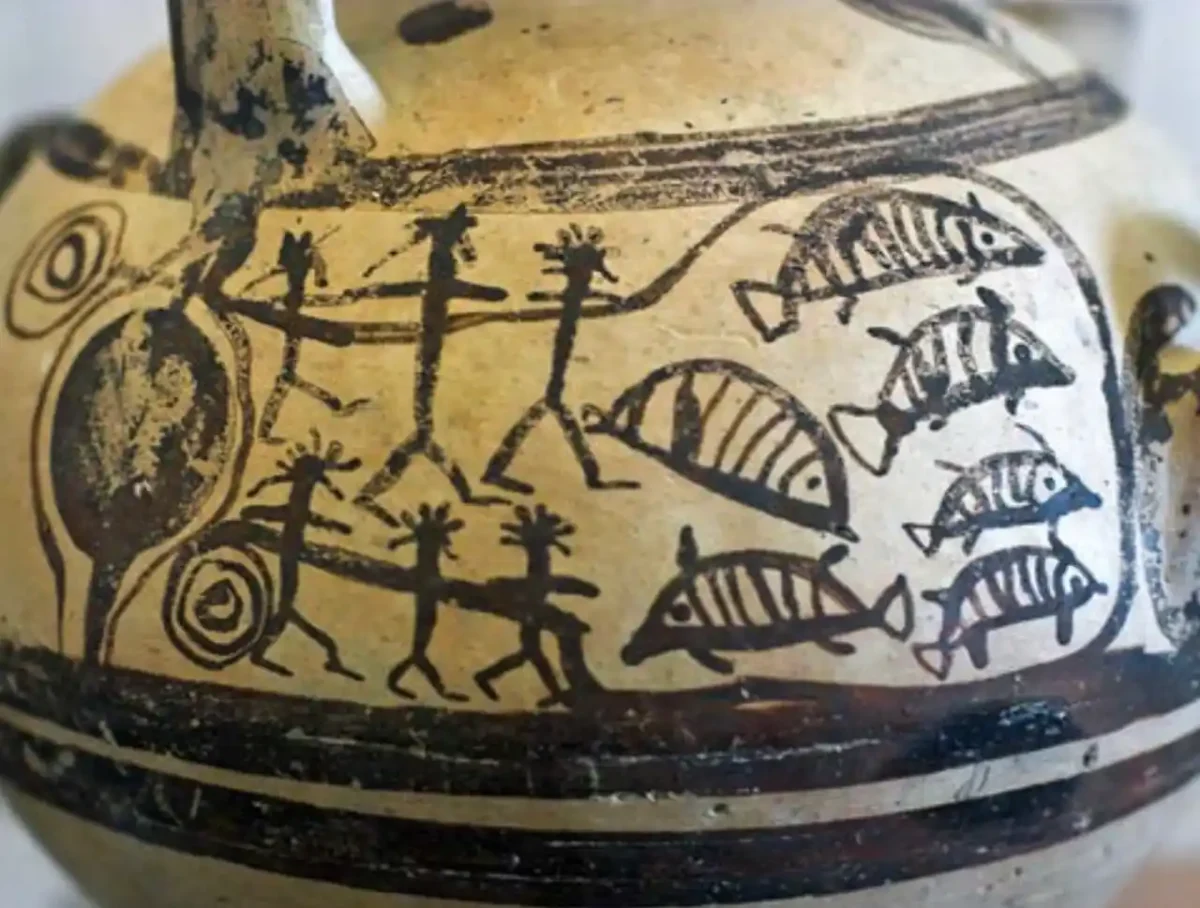
Two vessels decorated with scenes of communal fishing, discovered in Naxos and Kynos, reveal that this activity was not marginal, but rather a specialized task with social prestige in the 12th century BC.
For decades, historians have considered fishing a minor economic activity in the Mycenaean civilization of the Bronze Age. The absence of references to this practice in the Linear B tablets, the administrative archives of the palaces, seemed to confirm that fishing occupied a secondary place in the palatial economy, dominated by agriculture, livestock, and the control of raw materials.
However, a study published in the journal Thiasos by archaeologist Santo Privitera, of the University of Bologna, challenges this traditional view. Through a detailed analysis of two vessels decorated with fishing scenes, dated to the period known as Middle Late Helladic IIIC (approximately the 12th century BC), the researcher demonstrates that, far from being a minor task, net fishing was a complex, organized activity with deep social significance in the coastal communities that flourished after the collapse of the Mycenaean palaces.
The two key pieces in this research come from sites separated by hundreds of kilometers of sea: a small hydria (a vessel with a filter) found in a tomb in the Aplomata cemetery on the island of Naxos, and fragments of a krater discovered at the coastal settlement of Kynos, in Eastern Locris (central Greece). Both belong to the same period and share an exceptional theme: the realistic depiction of a group of people working with a large fishing net.

Images that tell a story
The Naxos piece, first published in 1996 by Olga Hadjianastasiou, shows on its decorative band six individuals arranged in two rows pulling a thick rope coiled into large spirals. On the right side of the scene, six large fish, possibly tuna, appear surrounded by the net. The scene is depicted from an aerial perspective, with the men on the shore and the fish in the water.
According to Privitera’s reinterpretation, a curvilinear rhombus-shaped motif painted in the scene, initially considered abstract, could represent a small boat seen from above, a detail that would reinforce the realism of the scene and explain the logistics of the fishing operation.
The scene on the Kynos krater, first published in 1999 by Fanouria Dakoronia, is even more explicit. Although the vessel is highly fragmented, its reconstruction reveals at least six individuals, also in two symmetrical rows, holding the ends of a rope.
The net is clearly depicted, and inside it swim fish of different sizes. In addition, the net is equipped with small circular protrusions that archaeologists unmistakably identify as weights, intended to keep the net taut and close to the seabed.

Ancestral technology: seine fishing
But, what type of fishing do these images represent? Privitera turns to comparative ethnography and experimental archaeology to identify the technique. It is seine fishing, a method using a drag net operated from the shore.
The method requires a boat that carries the net out to sea, tracing a semicircle to surround a school of fish, while one end of the net remains on the beach. Once the encirclement is complete, the net is dragged back to land by a group of men from the shore, thus capturing the fish.
This operational sequence is effectively reflected in the two scenes from Naxos and Kynos, which appear to depict the final moment, that is, the hauling of the net and the catch by the fishing team, Privitera explains in his article.
This technique, far from being an invention of the post-palatial period, was already documented. The discovery of numerous sets of lead net weights in earlier archaeological contexts (from the 14th century BC) in places such as the citadel of Gla, in Boeotia, or in tombs in Crete, Astypalaia, and Attica, demonstrates that large-scale net fishing was a known practice. However, what changes radically in the 12th century is its representation in art and, therefore, its social projection.

Banquet and prestige: fishing as a marker of identity
To understand the true meaning of these scenes, Privitera does not limit himself to analyzing the images but also studies the objects on which they are painted and the contexts in which they were found.
The Naxos vessel is a hydria, a highly specialized ceramic form equipped with a filter in the spout, which specialists associate with the consumption of fermented beverages or infusions in ceremonial contexts. The Aplomata tomb where it was found contained a true banquet set, with rhyta (libation vessels), jugs, and cups. Meanwhile, the Kynos krater is a vessel par excellence intended for the mixing of wine and water in symposia or communal banquets.
Not only the function of the vessels, but also the contexts in which they were found, suggest that these representations were linked to celebrations, the archaeologist argues. In the case of Naxos, an exceptional tomb has also been discovered in the nearby locality of Kamini, containing, along with gold jewelry and bronze spearheads, a set of lead net weights. This is possibly the burial of a prominent individual, a local hero, in which fishing tools appear at the same level as weapons, traditional symbols of status and power.
This association between fishing, weapons, and banquets leads Privitera to a fundamental conclusion: the scenes do not represent an egalitarian community of fishermen, as some scholars had suggested, but rather reflect the existence of specialized groups, likely under the leadership of individuals who owned the means of production (the nets, the boat) and organized the expeditions.
The absence of a chief or authority in the two scenes may only be apparent, Privitera warns. It does not exclude that the supply, management, and perhaps even the ownership of the required ‘means of production,’ such as nets, metal tools, and, most likely, a boat, were the domain of specific individuals, to whom a central role in organizing fishing activity could be attributed.
The end of an era and the rise of new leaderships
The collapse of the Mycenaean palaces around 1200 BC brought about a profound social restructuring. The rigid palatial hierarchies gave way to more local forms of organization, where power no longer stemmed so much from an administrative position as from prestige and the ability to mobilize resources and people. In this new context, activities such as navigation, warfare, and, as this study shows, fishing, became pillars for the legitimization of new elites.
Kynos itself, a coastal settlement, has yielded other ceramic fragments depicting warships with armed warriors. The combination of these martial themes with fishing scenes within the same material culture of the banquet suggests that, in the minds of these communities, maritime skills for both warfare and resource acquisition were intrinsically linked.
The imagery present in fine banquet ceramics combines ‘a culture for which maritime activity and conflict were part of a shared mindset,’ both for the decorators and for those who used these vessels during a banquet, Privitera quotes researcher A.R. Knodell.
Far from the idyllic image of a coastal task, the scenes from Naxos and Kynos speak of specialized work, coordinated effort, and the emergence of new social values. The presence of these themes on vessels used in banquets, and their association in tombs with weapons and luxury objects, indicates that fishing had ceased to be an invisible activity and had become a source of prestige and a marker of identity for the post-palatial Aegean coastal elites.
Ultimately, they [the leaders] may not even have directly participated in fishing activities, but, in all likelihood, they owned in life vessels such as the Naxos hydria and the Kynos krater and, once dead, were buried with the banquet sets that had helped make them prominent within their respective communities, Privitera concludes.
The study of these two singular vessels opens a privileged window into understanding how Greek communities reinvented themselves after the end of an era, finding in the sea not only a means of subsistence, but also a new source of power and social meaning.
SOURCES
S. Privitera, Rappresentare la pesca nell’Egeo postpalaziale: iconografia, tecnologia e proiezioni sociali. Thiasos 15, 2026, pp. 71-82


.jpg)


Comments